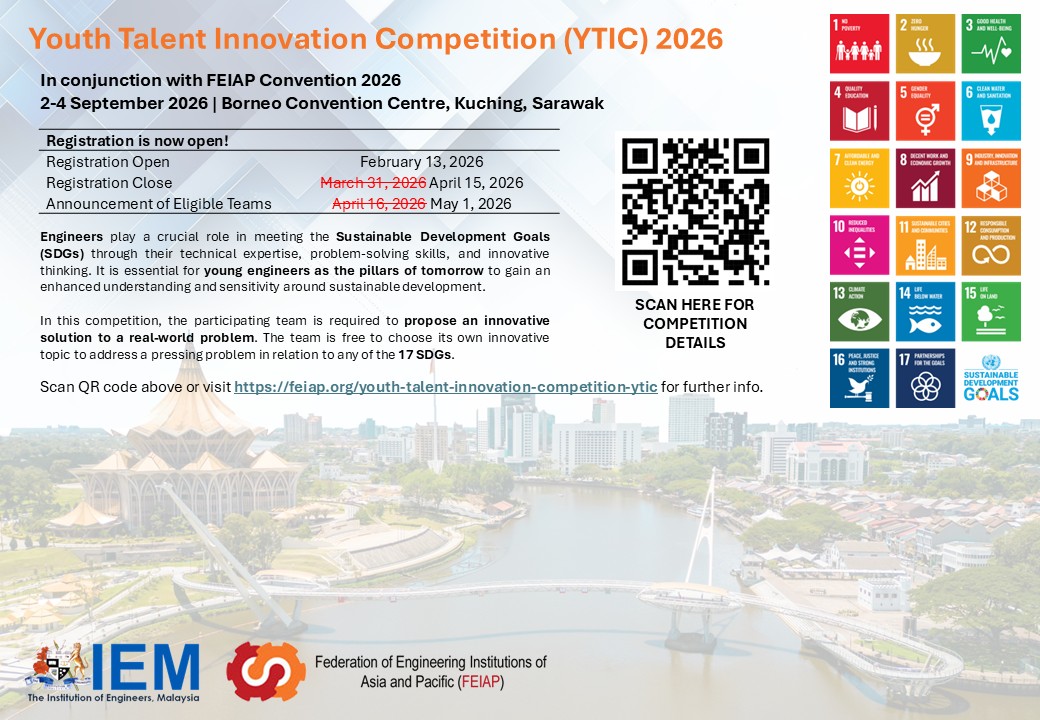
1. Goal 1 – No Poverty
      2. Goal 2 – Zero Hunger
      3. Goal 3 – Good Health and Well-Being
      4. Goal 4 – Quality Education
      5. Goal 5 – Gender Equality
      6. Goal 6 – Clean Water and Sanitation
      7. Goal 7 – Affordable and Clean Energy
      8. Goal 8 – Decent Work and Economic Growth
      9. Goal 9 – Industry, Innovation , Infrastructure
      10. Goal 10 – Reduce Inequalities
      11. Goal 11 – Sustainable Cities and Communities
      12. Goal 12 – Responsible Consumption and Production
      13. Goal 13 – Climate Action
      14. Goal 14 – Life Below Water
      15. Goal 15 – Life on Land
      16. Goal 16 – Peace, Justice and Strong Institutions
      17. Goal 17 – Partnerships for the Goals
      1. Participants should register as teams with the following:
          • Age must be more than 18 and below 40.
          • Teams should not be more than 7 persons, must include team leader (engineering background).
          • Each team shall have one coach or advisor who is not part in the team.
          • At least half of the members should be of engineering background, with the remaining members from non-engineering disciplines (e.g. finance, arts, marketing, etc.)
          • Where necessary, participants may need to obtain authorization from their respective workplace.
    1. Once registered, team members may not be changed without authorization from the respective organizing committee the team is registered with. If the organizing committee is not notified of the changes, the organizing committee has the right to disqualify the team.
    The competition will be separated into three phases, namely Registration Phase, Concept Phase and Final Phase. Materials to submit:
      • Registration Phase : Registration Form (Pre-Qualification)
      • Concept Phase       : Poster, 5-Minutes Pre-Record Video & Pitch (Online)
      • Final Phase              : Presentation at the convention
    A. Concept Phase For the Concept Phase, the following will be required to be submitted by the participating teams through the platform and will be given to the judges for participants to understand what their team is trying to accomplish. This information will be collected from the participating teams through an online form which will be setup by the organizing committee and must be completed before the submission deadline. Below are the topics that participants will be asked to address in their submission: 1. Title of Venture or Concept The title of the venture should be unique and representative of the concept. 2. Team Members Describe the team and what they are capable of for this venture.  What responsibilities will each hold, and what are their objectives during this competition? 3. Elevator Pitch Provide an elevator pitch of the concept in a single sentence in 200 characters or less.  It must communicate briefly and clearly what the venture is about and for whom. 4. Problem Statement Briefly describe what needs or opportunity that are addressing and why it should be addressed.  Why is this important? How big is this problem? 5. Description of Product/Service Frame out the venture’s solution to the above stated problem. What is the venture’s unique insight, approach or advantage to solving that problem, and how will it function? What are the key assumptions? 6. SDG Impact Select the Sustainable Development Goal (SDG) in which the venture generates the greatest impact? How will the venture work to accelerate the SDG you are addressing? What is the venture’s impact on communities, the economy and environment? How do the measure it? 7. Market Analysis For whom are the creating value with the solution of the venture is offering?  Who are the team trying to reach with the venture? What is the market size, growth potential, and how is the market trending now? 8. Business Model and Go-to-Market Strategy How will the make venture generate revenue or what is the business model? What’s the go-to-market strategy? How will it get users? 9. Competition How is this problem currently being solved or addressed? What do users do now without the product? Who are the direct and indirect competitors? Why would a user choose the solution over the competitors’ solutions? B. Final Phase For the Final Phase, participating teams will be asked to resubmit their entries with consideration of the feedback from the Judges. Below are the topics that participant will be asked to address in the submission in addition to the requested information from Concept Phase: 1. Supply Chain How the product or service will be produced and delivered? How will the venture secure resources require for production? Will the sources of raw materials enable to operate competitively and grow? How to deliver the product or service to reach its target customer? 2. Finances Provide an overview of the required resources and economics of the venture. Provide clearly and adequately a breakeven analysis and financial projections for the venture. What are the prospects for long-term profitability? Contact Info FEIAP Secretariat for materials submission and assistance. Ms. Valli Saminathan
    • Email: [email protected]
    • Tel:  +603-7890 0143
    • Address:
    • Federation of Engineering Institution of Asia and The Pacific c/o The Institution of Engineers, Malaysia Lots 60 & 62, Bangunan Ingenieur, Jalan 52/4, P.O. Box 223 (Jalan Sultan), 46720 Petaling Jaya, Selangor Darul Ehsan.
    Provide an overview of the required resources and economics of the venture. Provide clearly and adequately a breakeven analysis and financial projections for the venture. What are the prospects for long-term profitability? In accordance with the United Nation’s 9 of the 17 Sustainable Development Goals, enhance Young Engineers understanding and sensitivity to sustainable development.
      1. Goal 1 – No Poverty
      2. Goal 2 – Zero Hunger
      3. Goal 3 – Good Health and Well-Being
      4. Goal 4 – Quality Education
      5. Goal 5 – Gender Equality
      6. Goal 6 – Clean Water and Sanitation
      7. Goal 7 – Affordable and Clean Energy
      8. Goal 8 – Decent Work and Economic Growth
      9. Goal 9 – Industry, Innovation , Infrastructure
      10. Goal 10 – Reduce Inequalities
      11. Goal 11 – Sustainable Cities and Communities
      12. Goal 12 – Responsible Consumption and Production
      13. Goal 13 – Climate Action
      14. Goal 14 – Life Below Water
      15. Goal 15 – Life on Land
      16. Goal 16 – Peace, Justice and Strong Institutions
      17. Goal 17 – Partnerships for the Goals
      1. Participants should register as teams with the following:
          • Age must be more than 18 and below 40.
          • Teams should not be more than 7 persons, must include team leader (engineering background).
          • Each team shall have one coach or advisor who is not part in the team.
          • At least half of the members should be of engineering background, with the remaining members from non-engineering disciplines (e.g. finance, arts, marketing, etc.)
          • Where necessary, participants may need to obtain authorization from their respective workplace.
    1. Once registered, team members may not be changed without authorization from the respective organizing committee the team is registered with. If the organizing committee is not notified of the changes, the organizing committee has the right to disqualify the team.
    The competition will be separated into three phases, namely Registration Phase, Concept Phase and Final Phase. Materials to submit:
      • Registration Phase : Registration Form (Pre-Qualification)
      • Concept Phase       : Poster, 5-Minutes Pre-Record Video & Pitch (Online)
      • Final Phase              : Presentation at the convention
    A. Concept Phase For the Concept Phase, the following will be required to be submitted by the participating teams through the platform and will be given to the judges for participants to understand what their team is trying to accomplish. This information will be collected from the participating teams through an online form which will be setup by the organizing committee and must be completed before the submission deadline. Below are the topics that participants will be asked to address in their submission: 1. Title of Venture or Concept The title of the venture should be unique and representative of the concept. 2. Team Members Describe the team and what they are capable of for this venture.  What responsibilities will each hold, and what are their objectives during this competition? 3. Elevator Pitch Provide an elevator pitch of the concept in a single sentence in 200 characters or less.  It must communicate briefly and clearly what the venture is about and for whom. 4. Problem Statement Briefly describe what needs or opportunity that are addressing and why it should be addressed.  Why is this important? How big is this problem? 5. Description of Product/Service Frame out the venture’s solution to the above stated problem. What is the venture’s unique insight, approach or advantage to solving that problem, and how will it function? What are the key assumptions? 6. SDG Impact Select the Sustainable Development Goal (SDG) in which the venture generates the greatest impact? How will the venture work to accelerate the SDG you are addressing? What is the venture’s impact on communities, the economy and environment? How do the measure it? 7. Market Analysis For whom are the creating value with the solution of the venture is offering?  Who are the team trying to reach with the venture? What is the market size, growth potential, and how is the market trending now? 8. Business Model and Go-to-Market Strategy How will the make venture generate revenue or what is the business model? What’s the go-to-market strategy? How will it get users? 9. Competition How is this problem currently being solved or addressed? What do users do now without the product? Who are the direct and indirect competitors? Why would a user choose the solution over the competitors’ solutions? B. Final Phase For the Final Phase, participating teams will be asked to resubmit their entries with consideration of the feedback from the Judges. Below are the topics that participant will be asked to address in the submission in addition to the requested information from Concept Phase: 1. Supply Chain How the product or service will be produced and delivered? How will the venture secure resources require for production? Will the sources of raw materials enable to operate competitively and grow? How to deliver the product or service to reach its target customer? 2. Finances Provide an overview of the required resources and economics of the venture. Provide clearly and adequately a breakeven analysis and financial projections for the venture. What are the prospects for long-term profitability? Contact Info FEIAP Secretariat for materials submission and assistance. Ms. Valli Saminathan
    • Email: [email protected]
    • Tel:  +603-7890 0143
    • Address:
    • Federation of Engineering Institution of Asia and The Pacific c/o The Institution of Engineers, Malaysia Lots 60 & 62, Bangunan Ingenieur, Jalan 52/4, P.O. Box 223 (Jalan Sultan), 46720 Petaling Jaya, Selangor Darul Ehsan.
    Provide an overview of the required resources and economics of the venture. Provide clearly and adequately a breakeven analysis and financial projections for the venture. What are the prospects for long-term profitability? In accordance with the United Nation’s 9 of the 17 Sustainable Development Goals, enhance Young Engineers understanding and sensitivity to sustainable development.
      1. Goal 1 – No Poverty
      2. Goal 2 – Zero Hunger
      3. Goal 3 – Good Health and Well-Being
      4. Goal 4 – Quality Education
      5. Goal 5 – Gender Equality
      6. Goal 6 – Clean Water and Sanitation
      7. Goal 7 – Affordable and Clean Energy
      8. Goal 8 – Decent Work and Economic Growth
      9. Goal 9 – Industry, Innovation , Infrastructure
      10. Goal 10 – Reduce Inequalities
      11. Goal 11 – Sustainable Cities and Communities
      12. Goal 12 – Responsible Consumption and Production
      13. Goal 13 – Climate Action
      14. Goal 14 – Life Below Water
      15. Goal 15 – Life on Land
      16. Goal 16 – Peace, Justice and Strong Institutions
      17. Goal 17 – Partnerships for the Goals
      1. Participants should register as teams with the following:
          • Age must be more than 18 and below 40.
          • Teams should not be more than 7 persons, must include team leader (engineering background).
          • Each team shall have one coach or advisor who is not part in the team.
          • At least half of the members should be of engineering background, with the remaining members from non-engineering disciplines (e.g. finance, arts, marketing, etc.)
          • Where necessary, participants may need to obtain authorization from their respective workplace.
    1. Once registered, team members may not be changed without authorization from the respective organizing committee the team is registered with. If the organizing committee is not notified of the changes, the organizing committee has the right to disqualify the team.
    The competition will be separated into three phases, namely Registration Phase, Concept Phase and Final Phase. Materials to submit:
      • Registration Phase : Registration Form (Pre-Qualification)
      • Concept Phase       : Poster, 5-Minutes Pre-Record Video & Pitch (Online)
      • Final Phase              : Presentation at the convention
    A. Concept Phase For the Concept Phase, the following will be required to be submitted by the participating teams through the platform and will be given to the judges for participants to understand what their team is trying to accomplish. This information will be collected from the participating teams through an online form which will be setup by the organizing committee and must be completed before the submission deadline. Below are the topics that participants will be asked to address in their submission: 1. Title of Venture or Concept The title of the venture should be unique and representative of the concept. 2. Team Members Describe the team and what they are capable of for this venture.  What responsibilities will each hold, and what are their objectives during this competition? 3. Elevator Pitch Provide an elevator pitch of the concept in a single sentence in 200 characters or less.  It must communicate briefly and clearly what the venture is about and for whom. 4. Problem Statement Briefly describe what needs or opportunity that are addressing and why it should be addressed.  Why is this important? How big is this problem? 5. Description of Product/Service Frame out the venture’s solution to the above stated problem. What is the venture’s unique insight, approach or advantage to solving that problem, and how will it function? What are the key assumptions? 6. SDG Impact Select the Sustainable Development Goal (SDG) in which the venture generates the greatest impact? How will the venture work to accelerate the SDG you are addressing? What is the venture’s impact on communities, the economy and environment? How do the measure it? 7. Market Analysis For whom are the creating value with the solution of the venture is offering?  Who are the team trying to reach with the venture? What is the market size, growth potential, and how is the market trending now? 8. Business Model and Go-to-Market Strategy How will the make venture generate revenue or what is the business model? What’s the go-to-market strategy? How will it get users? 9. Competition How is this problem currently being solved or addressed? What do users do now without the product? Who are the direct and indirect competitors? Why would a user choose the solution over the competitors’ solutions? B. Final Phase For the Final Phase, participating teams will be asked to resubmit their entries with consideration of the feedback from the Judges. Below are the topics that participant will be asked to address in the submission in addition to the requested information from Concept Phase: 1. Supply Chain How the product or service will be produced and delivered? How will the venture secure resources require for production? Will the sources of raw materials enable to operate competitively and grow? How to deliver the product or service to reach its target customer? 2. Finances Provide an overview of the required resources and economics of the venture. Provide clearly and adequately a breakeven analysis and financial projections for the venture. What are the prospects for long-term profitability? Contact Info FEIAP Secretariat for materials submission and assistance. Ms. Valli Saminathan
    • Email: [email protected]
    • Tel:  +603-7890 0143
    • Address:
    • Federation of Engineering Institution of Asia and The Pacific c/o The Institution of Engineers, Malaysia Lots 60 & 62, Bangunan Ingenieur, Jalan 52/4, P.O. Box 223 (Jalan Sultan), 46720 Petaling Jaya, Selangor Darul Ehsan.
      • Registration Phase : Registration Form (Pre-Qualification)
      • Concept Phase       : Poster, 5-Minutes Pre-Record Video & Pitch (Online)
      • Final Phase              : Presentation at the convention
    A. Concept Phase For the Concept Phase, the following will be required to be submitted by the participating teams through the platform and will be given to the judges for participants to understand what their team is trying to accomplish. This information will be collected from the participating teams through an online form which will be setup by the organizing committee and must be completed before the submission deadline. Below are the topics that participants will be asked to address in their submission: 1. Title of Venture or Concept The title of the venture should be unique and representative of the concept. 2. Team Members Describe the team and what they are capable of for this venture.  What responsibilities will each hold, and what are their objectives during this competition? 3. Elevator Pitch Provide an elevator pitch of the concept in a single sentence in 200 characters or less.  It must communicate briefly and clearly what the venture is about and for whom. 4. Problem Statement Briefly describe what needs or opportunity that are addressing and why it should be addressed.  Why is this important? How big is this problem? 5. Description of Product/Service Frame out the venture’s solution to the above stated problem. What is the venture’s unique insight, approach or advantage to solving that problem, and how will it function? What are the key assumptions? 6. SDG Impact Select the Sustainable Development Goal (SDG) in which the venture generates the greatest impact? How will the venture work to accelerate the SDG you are addressing? What is the venture’s impact on communities, the economy and environment? How do the measure it? 7. Market Analysis For whom are the creating value with the solution of the venture is offering?  Who are the team trying to reach with the venture? What is the market size, growth potential, and how is the market trending now? 8. Business Model and Go-to-Market Strategy How will the make venture generate revenue or what is the business model? What’s the go-to-market strategy? How will it get users? 9. Competition How is this problem currently being solved or addressed? What do users do now without the product? Who are the direct and indirect competitors? Why would a user choose the solution over the competitors’ solutions? B. Final Phase For the Final Phase, participating teams will be asked to resubmit their entries with consideration of the feedback from the Judges. Below are the topics that participant will be asked to address in the submission in addition to the requested information from Concept Phase: 1. Supply Chain How the product or service will be produced and delivered? How will the venture secure resources require for production? Will the sources of raw materials enable to operate competitively and grow? How to deliver the product or service to reach its target customer? 2. Finances Provide an overview of the required resources and economics of the venture. Provide clearly and adequately a breakeven analysis and financial projections for the venture. What are the prospects for long-term profitability?
    In accordance with the United Nation’s 9 of the 17 Sustainable Development Goals, enhance Young Engineers understanding and sensitivity to sustainable development.
      1. Goal 1 – No Poverty
      2. Goal 2 – Zero Hunger
      3. Goal 3 – Good Health and Well-Being
      4. Goal 4 – Quality Education
      5. Goal 5 – Gender Equality
      6. Goal 6 – Clean Water and Sanitation
      7. Goal 7 – Affordable and Clean Energy
      8. Goal 8 – Decent Work and Economic Growth
      9. Goal 9 – Industry, Innovation , Infrastructure
      10. Goal 10 – Reduce Inequalities
      11. Goal 11 – Sustainable Cities and Communities
      12. Goal 12 – Responsible Consumption and Production
      13. Goal 13 – Climate Action
      14. Goal 14 – Life Below Water
      15. Goal 15 – Life on Land
      16. Goal 16 – Peace, Justice and Strong Institutions
      17. Goal 17 – Partnerships for the Goals
      1. Participants should register as teams with the following:
          • Age must be more than 18 and below 40.
          • Teams should not be more than 7 persons, must include team leader (engineering background).
          • Each team shall have one coach or advisor who is not part in the team.
          • At least half of the members should be of engineering background, with the remaining members from non-engineering disciplines (e.g. finance, arts, marketing, etc.)
          • Where necessary, participants may need to obtain authorization from their respective workplace.
    1. Once registered, team members may not be changed without authorization from the respective organizing committee the team is registered with. If the organizing committee is not notified of the changes, the organizing committee has the right to disqualify the team.
    The competition will be separated into three phases, namely Registration Phase, Concept Phase and Final Phase. Materials to submit:
      • Registration Phase : Registration Form (Pre-Qualification)
      • Concept Phase       : Poster, 5-Minutes Pre-Record Video & Pitch (Online)
      • Final Phase              : Presentation at the convention
    A. Concept Phase For the Concept Phase, the following will be required to be submitted by the participating teams through the platform and will be given to the judges for participants to understand what their team is trying to accomplish. This information will be collected from the participating teams through an online form which will be setup by the organizing committee and must be completed before the submission deadline. Below are the topics that participants will be asked to address in their submission: 1. Title of Venture or Concept The title of the venture should be unique and representative of the concept. 2. Team Members Describe the team and what they are capable of for this venture.  What responsibilities will each hold, and what are their objectives during this competition? 3. Elevator Pitch Provide an elevator pitch of the concept in a single sentence in 200 characters or less.  It must communicate briefly and clearly what the venture is about and for whom. 4. Problem Statement Briefly describe what needs or opportunity that are addressing and why it should be addressed.  Why is this important? How big is this problem? 5. Description of Product/Service Frame out the venture’s solution to the above stated problem. What is the venture’s unique insight, approach or advantage to solving that problem, and how will it function? What are the key assumptions? 6. SDG Impact Select the Sustainable Development Goal (SDG) in which the venture generates the greatest impact? How will the venture work to accelerate the SDG you are addressing? What is the venture’s impact on communities, the economy and environment? How do the measure it? 7. Market Analysis For whom are the creating value with the solution of the venture is offering?  Who are the team trying to reach with the venture? What is the market size, growth potential, and how is the market trending now? 8. Business Model and Go-to-Market Strategy How will the make venture generate revenue or what is the business model? What’s the go-to-market strategy? How will it get users? 9. Competition How is this problem currently being solved or addressed? What do users do now without the product? Who are the direct and indirect competitors? Why would a user choose the solution over the competitors’ solutions? B. Final Phase For the Final Phase, participating teams will be asked to resubmit their entries with consideration of the feedback from the Judges. Below are the topics that participant will be asked to address in the submission in addition to the requested information from Concept Phase: 1. Supply Chain How the product or service will be produced and delivered? How will the venture secure resources require for production? Will the sources of raw materials enable to operate competitively and grow? How to deliver the product or service to reach its target customer? 2. Finances Provide an overview of the required resources and economics of the venture. Provide clearly and adequately a breakeven analysis and financial projections for the venture. What are the prospects for long-term profitability? Contact Info FEIAP Secretariat for materials submission and assistance. Ms. Valli Saminathan
    • Email: [email protected]
    • Tel:  +603-7890 0143
    • Address:
    • Federation of Engineering Institution of Asia and The Pacific c/o The Institution of Engineers, Malaysia Lots 60 & 62, Bangunan Ingenieur, Jalan 52/4, P.O. Box 223 (Jalan Sultan), 46720 Petaling Jaya, Selangor Darul Ehsan.
      1. Goal 1 – No Poverty
      2. Goal 2 – Zero Hunger
      3. Goal 3 – Good Health and Well-Being
      4. Goal 4 – Quality Education
      5. Goal 5 – Gender Equality
      6. Goal 6 – Clean Water and Sanitation
      7. Goal 7 – Affordable and Clean Energy
      8. Goal 8 – Decent Work and Economic Growth
      9. Goal 9 – Industry, Innovation , Infrastructure
      10. Goal 10 – Reduce Inequalities
      11. Goal 11 – Sustainable Cities and Communities
      12. Goal 12 – Responsible Consumption and Production
      13. Goal 13 – Climate Action
      14. Goal 14 – Life Below Water
      15. Goal 15 – Life on Land
      16. Goal 16 – Peace, Justice and Strong Institutions
      17. Goal 17 – Partnerships for the Goals
      1. Participants should register as teams with the following:
          • Age must be more than 18 and below 40.
          • Teams should not be more than 7 persons, must include team leader (engineering background).
          • Each team shall have one coach or advisor who is not part in the team.
          • At least half of the members should be of engineering background, with the remaining members from non-engineering disciplines (e.g. finance, arts, marketing, etc.)
          • Where necessary, participants may need to obtain authorization from their respective workplace.
    1. Once registered, team members may not be changed without authorization from the respective organizing committee the team is registered with. If the organizing committee is not notified of the changes, the organizing committee has the right to disqualify the team.
    The competition will be separated into three phases, namely Registration Phase, Concept Phase and Final Phase. Materials to submit:
      • Registration Phase : Registration Form (Pre-Qualification)
      • Concept Phase       : Poster, 5-Minutes Pre-Record Video & Pitch (Online)
      • Final Phase              : Presentation at the convention
    A. Concept Phase For the Concept Phase, the following will be required to be submitted by the participating teams through the platform and will be given to the judges for participants to understand what their team is trying to accomplish. This information will be collected from the participating teams through an online form which will be setup by the organizing committee and must be completed before the submission deadline. Below are the topics that participants will be asked to address in their submission: 1. Title of Venture or Concept The title of the venture should be unique and representative of the concept. 2. Team Members Describe the team and what they are capable of for this venture.  What responsibilities will each hold, and what are their objectives during this competition? 3. Elevator Pitch Provide an elevator pitch of the concept in a single sentence in 200 characters or less.  It must communicate briefly and clearly what the venture is about and for whom. 4. Problem Statement Briefly describe what needs or opportunity that are addressing and why it should be addressed.  Why is this important? How big is this problem? 5. Description of Product/Service Frame out the venture’s solution to the above stated problem. What is the venture’s unique insight, approach or advantage to solving that problem, and how will it function? What are the key assumptions? 6. SDG Impact Select the Sustainable Development Goal (SDG) in which the venture generates the greatest impact? How will the venture work to accelerate the SDG you are addressing? What is the venture’s impact on communities, the economy and environment? How do the measure it? 7. Market Analysis For whom are the creating value with the solution of the venture is offering?  Who are the team trying to reach with the venture? What is the market size, growth potential, and how is the market trending now? 8. Business Model and Go-to-Market Strategy How will the make venture generate revenue or what is the business model? What’s the go-to-market strategy? How will it get users? 9. Competition How is this problem currently being solved or addressed? What do users do now without the product? Who are the direct and indirect competitors? Why would a user choose the solution over the competitors’ solutions? B. Final Phase For the Final Phase, participating teams will be asked to resubmit their entries with consideration of the feedback from the Judges. Below are the topics that participant will be asked to address in the submission in addition to the requested information from Concept Phase: 1. Supply Chain How the product or service will be produced and delivered? How will the venture secure resources require for production? Will the sources of raw materials enable to operate competitively and grow? How to deliver the product or service to reach its target customer? 2. Finances Provide an overview of the required resources and economics of the venture. Provide clearly and adequately a breakeven analysis and financial projections for the venture. What are the prospects for long-term profitability?
    In accordance with the United Nation’s 9 of the 17 Sustainable Development Goals, enhance Young Engineers understanding and sensitivity to sustainable development.
      1. Goal 1 – No Poverty
      2. Goal 2 – Zero Hunger
      3. Goal 3 – Good Health and Well-Being
      4. Goal 4 – Quality Education
      5. Goal 5 – Gender Equality
      6. Goal 6 – Clean Water and Sanitation
      7. Goal 7 – Affordable and Clean Energy
      8. Goal 8 – Decent Work and Economic Growth
      9. Goal 9 – Industry, Innovation , Infrastructure
      10. Goal 10 – Reduce Inequalities
      11. Goal 11 – Sustainable Cities and Communities
      12. Goal 12 – Responsible Consumption and Production
      13. Goal 13 – Climate Action
      14. Goal 14 – Life Below Water
      15. Goal 15 – Life on Land
      16. Goal 16 – Peace, Justice and Strong Institutions
      17. Goal 17 – Partnerships for the Goals
      1. Participants should register as teams with the following:
          • Age must be more than 18 and below 40.
          • Teams should not be more than 7 persons, must include team leader (engineering background).
          • Each team shall have one coach or advisor who is not part in the team.
          • At least half of the members should be of engineering background, with the remaining members from non-engineering disciplines (e.g. finance, arts, marketing, etc.)
          • Where necessary, participants may need to obtain authorization from their respective workplace.
    1. Once registered, team members may not be changed without authorization from the respective organizing committee the team is registered with. If the organizing committee is not notified of the changes, the organizing committee has the right to disqualify the team.
    The competition will be separated into three phases, namely Registration Phase, Concept Phase and Final Phase. Materials to submit:
      • Registration Phase : Registration Form (Pre-Qualification)
      • Concept Phase       : Poster, 5-Minutes Pre-Record Video & Pitch (Online)
      • Final Phase              : Presentation at the convention
    A. Concept Phase For the Concept Phase, the following will be required to be submitted by the participating teams through the platform and will be given to the judges for participants to understand what their team is trying to accomplish. This information will be collected from the participating teams through an online form which will be setup by the organizing committee and must be completed before the submission deadline. Below are the topics that participants will be asked to address in their submission: 1. Title of Venture or Concept The title of the venture should be unique and representative of the concept. 2. Team Members Describe the team and what they are capable of for this venture.  What responsibilities will each hold, and what are their objectives during this competition? 3. Elevator Pitch Provide an elevator pitch of the concept in a single sentence in 200 characters or less.  It must communicate briefly and clearly what the venture is about and for whom. 4. Problem Statement Briefly describe what needs or opportunity that are addressing and why it should be addressed.  Why is this important? How big is this problem? 5. Description of Product/Service Frame out the venture’s solution to the above stated problem. What is the venture’s unique insight, approach or advantage to solving that problem, and how will it function? What are the key assumptions? 6. SDG Impact Select the Sustainable Development Goal (SDG) in which the venture generates the greatest impact? How will the venture work to accelerate the SDG you are addressing? What is the venture’s impact on communities, the economy and environment? How do the measure it? 7. Market Analysis For whom are the creating value with the solution of the venture is offering?  Who are the team trying to reach with the venture? What is the market size, growth potential, and how is the market trending now? 8. Business Model and Go-to-Market Strategy How will the make venture generate revenue or what is the business model? What’s the go-to-market strategy? How will it get users? 9. Competition How is this problem currently being solved or addressed? What do users do now without the product? Who are the direct and indirect competitors? Why would a user choose the solution over the competitors’ solutions? B. Final Phase For the Final Phase, participating teams will be asked to resubmit their entries with consideration of the feedback from the Judges. Below are the topics that participant will be asked to address in the submission in addition to the requested information from Concept Phase: 1. Supply Chain How the product or service will be produced and delivered? How will the venture secure resources require for production? Will the sources of raw materials enable to operate competitively and grow? How to deliver the product or service to reach its target customer? 2. Finances Provide an overview of the required resources and economics of the venture. Provide clearly and adequately a breakeven analysis and financial projections for the venture. What are the prospects for long-term profitability? Contact Info FEIAP Secretariat for materials submission and assistance. Ms. Valli Saminathan
    • Email: [email protected]
    • Tel:  +603-7890 0143
    • Address:
    • Federation of Engineering Institution of Asia and The Pacific c/o The Institution of Engineers, Malaysia Lots 60 & 62, Bangunan Ingenieur, Jalan 52/4, P.O. Box 223 (Jalan Sultan), 46720 Petaling Jaya, Selangor Darul Ehsan.
    Objectives
    • To foster next generation of engineers through innovations and design thinking.
    • To leverage on international platform in providing opportunity for aspiring engineers to broaden their horizon and present their ideas.
    • To step out of typical boundaries and provide opportunities for industry and engineers across different disciplines to collaborate on novel solutions.
    In accordance with the United Nation’s 9 of the 17 Sustainable Development Goals, enhance Young Engineers understanding and sensitivity to sustainable development.
      1. Goal 1 – No Poverty
      2. Goal 2 – Zero Hunger
      3. Goal 3 – Good Health and Well-Being
      4. Goal 4 – Quality Education
      5. Goal 5 – Gender Equality
      6. Goal 6 – Clean Water and Sanitation
      7. Goal 7 – Affordable and Clean Energy
      8. Goal 8 – Decent Work and Economic Growth
      9. Goal 9 – Industry, Innovation , Infrastructure
      10. Goal 10 – Reduce Inequalities
      11. Goal 11 – Sustainable Cities and Communities
      12. Goal 12 – Responsible Consumption and Production
      13. Goal 13 – Climate Action
      14. Goal 14 – Life Below Water
      15. Goal 15 – Life on Land
      16. Goal 16 – Peace, Justice and Strong Institutions
      17. Goal 17 – Partnerships for the Goals
      1. Participants should register as teams with the following:
          • Age must be more than 18 and below 40.
          • Teams should not be more than 7 persons, must include team leader (engineering background).
          • Each team shall have one coach or advisor who is not part in the team.
          • At least half of the members should be of engineering background, with the remaining members from non-engineering disciplines (e.g. finance, arts, marketing, etc.)
          • Where necessary, participants may need to obtain authorization from their respective workplace.
    1. Once registered, team members may not be changed without authorization from the respective organizing committee the team is registered with. If the organizing committee is not notified of the changes, the organizing committee has the right to disqualify the team.
    The competition will be separated into three phases, namely Registration Phase, Concept Phase and Final Phase. Materials to submit:
      • Registration Phase : Registration Form (Pre-Qualification)
      • Concept Phase       : Poster, 5-Minutes Pre-Record Video & Pitch (Online)
      • Final Phase              : Presentation at the convention
    A. Concept Phase For the Concept Phase, the following will be required to be submitted by the participating teams through the platform and will be given to the judges for participants to understand what their team is trying to accomplish. This information will be collected from the participating teams through an online form which will be setup by the organizing committee and must be completed before the submission deadline. Below are the topics that participants will be asked to address in their submission: 1. Title of Venture or Concept The title of the venture should be unique and representative of the concept. 2. Team Members Describe the team and what they are capable of for this venture.  What responsibilities will each hold, and what are their objectives during this competition? 3. Elevator Pitch Provide an elevator pitch of the concept in a single sentence in 200 characters or less.  It must communicate briefly and clearly what the venture is about and for whom. 4. Problem Statement Briefly describe what needs or opportunity that are addressing and why it should be addressed.  Why is this important? How big is this problem? 5. Description of Product/Service Frame out the venture’s solution to the above stated problem. What is the venture’s unique insight, approach or advantage to solving that problem, and how will it function? What are the key assumptions? 6. SDG Impact Select the Sustainable Development Goal (SDG) in which the venture generates the greatest impact? How will the venture work to accelerate the SDG you are addressing? What is the venture’s impact on communities, the economy and environment? How do the measure it? 7. Market Analysis For whom are the creating value with the solution of the venture is offering?  Who are the team trying to reach with the venture? What is the market size, growth potential, and how is the market trending now? 8. Business Model and Go-to-Market Strategy How will the make venture generate revenue or what is the business model? What’s the go-to-market strategy? How will it get users? 9. Competition How is this problem currently being solved or addressed? What do users do now without the product? Who are the direct and indirect competitors? Why would a user choose the solution over the competitors’ solutions? B. Final Phase For the Final Phase, participating teams will be asked to resubmit their entries with consideration of the feedback from the Judges. Below are the topics that participant will be asked to address in the submission in addition to the requested information from Concept Phase: 1. Supply Chain How the product or service will be produced and delivered? How will the venture secure resources require for production? Will the sources of raw materials enable to operate competitively and grow? How to deliver the product or service to reach its target customer? 2. Finances Provide an overview of the required resources and economics of the venture. Provide clearly and adequately a breakeven analysis and financial projections for the venture. What are the prospects for long-term profitability?
    In accordance with the United Nation’s 9 of the 17 Sustainable Development Goals, enhance Young Engineers understanding and sensitivity to sustainable development.
      1. Goal 1 – No Poverty
      2. Goal 2 – Zero Hunger
      3. Goal 3 – Good Health and Well-Being
      4. Goal 4 – Quality Education
      5. Goal 5 – Gender Equality
      6. Goal 6 – Clean Water and Sanitation
      7. Goal 7 – Affordable and Clean Energy
      8. Goal 8 – Decent Work and Economic Growth
      9. Goal 9 – Industry, Innovation , Infrastructure
      10. Goal 10 – Reduce Inequalities
      11. Goal 11 – Sustainable Cities and Communities
      12. Goal 12 – Responsible Consumption and Production
      13. Goal 13 – Climate Action
      14. Goal 14 – Life Below Water
      15. Goal 15 – Life on Land
      16. Goal 16 – Peace, Justice and Strong Institutions
      17. Goal 17 – Partnerships for the Goals
      1. Participants should register as teams with the following:
          • Age must be more than 18 and below 40.
          • Teams should not be more than 7 persons, must include team leader (engineering background).
          • Each team shall have one coach or advisor who is not part in the team.
          • At least half of the members should be of engineering background, with the remaining members from non-engineering disciplines (e.g. finance, arts, marketing, etc.)
          • Where necessary, participants may need to obtain authorization from their respective workplace.
    1. Once registered, team members may not be changed without authorization from the respective organizing committee the team is registered with. If the organizing committee is not notified of the changes, the organizing committee has the right to disqualify the team.
    The competition will be separated into three phases, namely Registration Phase, Concept Phase and Final Phase. Materials to submit:
      • Registration Phase : Registration Form (Pre-Qualification)
      • Concept Phase       : Poster, 5-Minutes Pre-Record Video & Pitch (Online)
      • Final Phase              : Presentation at the convention
    A. Concept Phase For the Concept Phase, the following will be required to be submitted by the participating teams through the platform and will be given to the judges for participants to understand what their team is trying to accomplish. This information will be collected from the participating teams through an online form which will be setup by the organizing committee and must be completed before the submission deadline. Below are the topics that participants will be asked to address in their submission: 1. Title of Venture or Concept The title of the venture should be unique and representative of the concept. 2. Team Members Describe the team and what they are capable of for this venture.  What responsibilities will each hold, and what are their objectives during this competition? 3. Elevator Pitch Provide an elevator pitch of the concept in a single sentence in 200 characters or less.  It must communicate briefly and clearly what the venture is about and for whom. 4. Problem Statement Briefly describe what needs or opportunity that are addressing and why it should be addressed.  Why is this important? How big is this problem? 5. Description of Product/Service Frame out the venture’s solution to the above stated problem. What is the venture’s unique insight, approach or advantage to solving that problem, and how will it function? What are the key assumptions? 6. SDG Impact Select the Sustainable Development Goal (SDG) in which the venture generates the greatest impact? How will the venture work to accelerate the SDG you are addressing? What is the venture’s impact on communities, the economy and environment? How do the measure it? 7. Market Analysis For whom are the creating value with the solution of the venture is offering?  Who are the team trying to reach with the venture? What is the market size, growth potential, and how is the market trending now? 8. Business Model and Go-to-Market Strategy How will the make venture generate revenue or what is the business model? What’s the go-to-market strategy? How will it get users? 9. Competition How is this problem currently being solved or addressed? What do users do now without the product? Who are the direct and indirect competitors? Why would a user choose the solution over the competitors’ solutions? B. Final Phase For the Final Phase, participating teams will be asked to resubmit their entries with consideration of the feedback from the Judges. Below are the topics that participant will be asked to address in the submission in addition to the requested information from Concept Phase: 1. Supply Chain How the product or service will be produced and delivered? How will the venture secure resources require for production? Will the sources of raw materials enable to operate competitively and grow? How to deliver the product or service to reach its target customer? 2. Finances Provide an overview of the required resources and economics of the venture. Provide clearly and adequately a breakeven analysis and financial projections for the venture. What are the prospects for long-term profitability? Contact Info FEIAP Secretariat for materials submission and assistance. Ms. Valli Saminathan
    • Email: [email protected]
    • Tel:  +603-7890 0143
    • Address:
    • Federation of Engineering Institution of Asia and The Pacific c/o The Institution of Engineers, Malaysia Lots 60 & 62, Bangunan Ingenieur, Jalan 52/4, P.O. Box 223 (Jalan Sultan), 46720 Petaling Jaya, Selangor Darul Ehsan.
    Objectives
    • To foster next generation of engineers through innovations and design thinking.
    • To leverage on international platform in providing opportunity for aspiring engineers to broaden their horizon and present their ideas.
    • To step out of typical boundaries and provide opportunities for industry and engineers across different disciplines to collaborate on novel solutions.
    In accordance with the United Nation’s 9 of the 17 Sustainable Development Goals, enhance Young Engineers understanding and sensitivity to sustainable development.
      1. Goal 1 – No Poverty
      2. Goal 2 – Zero Hunger
      3. Goal 3 – Good Health and Well-Being
      4. Goal 4 – Quality Education
      5. Goal 5 – Gender Equality
      6. Goal 6 – Clean Water and Sanitation
      7. Goal 7 – Affordable and Clean Energy
      8. Goal 8 – Decent Work and Economic Growth
      9. Goal 9 – Industry, Innovation , Infrastructure
      10. Goal 10 – Reduce Inequalities
      11. Goal 11 – Sustainable Cities and Communities
      12. Goal 12 – Responsible Consumption and Production
      13. Goal 13 – Climate Action
      14. Goal 14 – Life Below Water
      15. Goal 15 – Life on Land
      16. Goal 16 – Peace, Justice and Strong Institutions
      17. Goal 17 – Partnerships for the Goals
      1. Participants should register as teams with the following:
          • Age must be more than 18 and below 40.
          • Teams should not be more than 7 persons, must include team leader (engineering background).
          • Each team shall have one coach or advisor who is not part in the team.
          • At least half of the members should be of engineering background, with the remaining members from non-engineering disciplines (e.g. finance, arts, marketing, etc.)
          • Where necessary, participants may need to obtain authorization from their respective workplace.
    1. Once registered, team members may not be changed without authorization from the respective organizing committee the team is registered with. If the organizing committee is not notified of the changes, the organizing committee has the right to disqualify the team.
    The competition will be separated into three phases, namely Registration Phase, Concept Phase and Final Phase. Materials to submit:
      • Registration Phase : Registration Form (Pre-Qualification)
      • Concept Phase       : Poster, 5-Minutes Pre-Record Video & Pitch (Online)
      • Final Phase              : Presentation at the convention
    A. Concept Phase For the Concept Phase, the following will be required to be submitted by the participating teams through the platform and will be given to the judges for participants to understand what their team is trying to accomplish. This information will be collected from the participating teams through an online form which will be setup by the organizing committee and must be completed before the submission deadline. Below are the topics that participants will be asked to address in their submission: 1. Title of Venture or Concept The title of the venture should be unique and representative of the concept. 2. Team Members Describe the team and what they are capable of for this venture.  What responsibilities will each hold, and what are their objectives during this competition? 3. Elevator Pitch Provide an elevator pitch of the concept in a single sentence in 200 characters or less.  It must communicate briefly and clearly what the venture is about and for whom. 4. Problem Statement Briefly describe what needs or opportunity that are addressing and why it should be addressed.  Why is this important? How big is this problem? 5. Description of Product/Service Frame out the venture’s solution to the above stated problem. What is the venture’s unique insight, approach or advantage to solving that problem, and how will it function? What are the key assumptions? 6. SDG Impact Select the Sustainable Development Goal (SDG) in which the venture generates the greatest impact? How will the venture work to accelerate the SDG you are addressing? What is the venture’s impact on communities, the economy and environment? How do the measure it? 7. Market Analysis For whom are the creating value with the solution of the venture is offering?  Who are the team trying to reach with the venture? What is the market size, growth potential, and how is the market trending now? 8. Business Model and Go-to-Market Strategy How will the make venture generate revenue or what is the business model? What’s the go-to-market strategy? How will it get users? 9. Competition How is this problem currently being solved or addressed? What do users do now without the product? Who are the direct and indirect competitors? Why would a user choose the solution over the competitors’ solutions? B. Final Phase For the Final Phase, participating teams will be asked to resubmit their entries with consideration of the feedback from the Judges. Below are the topics that participant will be asked to address in the submission in addition to the requested information from Concept Phase: 1. Supply Chain How the product or service will be produced and delivered? How will the venture secure resources require for production? Will the sources of raw materials enable to operate competitively and grow? How to deliver the product or service to reach its target customer? 2. Finances Provide an overview of the required resources and economics of the venture. Provide clearly and adequately a breakeven analysis and financial projections for the venture. What are the prospects for long-term profitability?
    In accordance with the United Nation’s 9 of the 17 Sustainable Development Goals, enhance Young Engineers understanding and sensitivity to sustainable development.
      1. Goal 1 – No Poverty
      2. Goal 2 – Zero Hunger
      3. Goal 3 – Good Health and Well-Being
      4. Goal 4 – Quality Education
      5. Goal 5 – Gender Equality
      6. Goal 6 – Clean Water and Sanitation
      7. Goal 7 – Affordable and Clean Energy
      8. Goal 8 – Decent Work and Economic Growth
      9. Goal 9 – Industry, Innovation , Infrastructure
      10. Goal 10 – Reduce Inequalities
      11. Goal 11 – Sustainable Cities and Communities
      12. Goal 12 – Responsible Consumption and Production
      13. Goal 13 – Climate Action
      14. Goal 14 – Life Below Water
      15. Goal 15 – Life on Land
      16. Goal 16 – Peace, Justice and Strong Institutions
      17. Goal 17 – Partnerships for the Goals
      1. Participants should register as teams with the following:
          • Age must be more than 18 and below 40.
          • Teams should not be more than 7 persons, must include team leader (engineering background).
          • Each team shall have one coach or advisor who is not part in the team.
          • At least half of the members should be of engineering background, with the remaining members from non-engineering disciplines (e.g. finance, arts, marketing, etc.)
          • Where necessary, participants may need to obtain authorization from their respective workplace.
    1. Once registered, team members may not be changed without authorization from the respective organizing committee the team is registered with. If the organizing committee is not notified of the changes, the organizing committee has the right to disqualify the team.
    The competition will be separated into three phases, namely Registration Phase, Concept Phase and Final Phase. Materials to submit:
      • Registration Phase : Registration Form (Pre-Qualification)
      • Concept Phase       : Poster, 5-Minutes Pre-Record Video & Pitch (Online)
      • Final Phase              : Presentation at the convention
    A. Concept Phase For the Concept Phase, the following will be required to be submitted by the participating teams through the platform and will be given to the judges for participants to understand what their team is trying to accomplish. This information will be collected from the participating teams through an online form which will be setup by the organizing committee and must be completed before the submission deadline. Below are the topics that participants will be asked to address in their submission: 1. Title of Venture or Concept The title of the venture should be unique and representative of the concept. 2. Team Members Describe the team and what they are capable of for this venture.  What responsibilities will each hold, and what are their objectives during this competition? 3. Elevator Pitch Provide an elevator pitch of the concept in a single sentence in 200 characters or less.  It must communicate briefly and clearly what the venture is about and for whom. 4. Problem Statement Briefly describe what needs or opportunity that are addressing and why it should be addressed.  Why is this important? How big is this problem? 5. Description of Product/Service Frame out the venture’s solution to the above stated problem. What is the venture’s unique insight, approach or advantage to solving that problem, and how will it function? What are the key assumptions? 6. SDG Impact Select the Sustainable Development Goal (SDG) in which the venture generates the greatest impact? How will the venture work to accelerate the SDG you are addressing? What is the venture’s impact on communities, the economy and environment? How do the measure it? 7. Market Analysis For whom are the creating value with the solution of the venture is offering?  Who are the team trying to reach with the venture? What is the market size, growth potential, and how is the market trending now? 8. Business Model and Go-to-Market Strategy How will the make venture generate revenue or what is the business model? What’s the go-to-market strategy? How will it get users? 9. Competition How is this problem currently being solved or addressed? What do users do now without the product? Who are the direct and indirect competitors? Why would a user choose the solution over the competitors’ solutions? B. Final Phase For the Final Phase, participating teams will be asked to resubmit their entries with consideration of the feedback from the Judges. Below are the topics that participant will be asked to address in the submission in addition to the requested information from Concept Phase: 1. Supply Chain How the product or service will be produced and delivered? How will the venture secure resources require for production? Will the sources of raw materials enable to operate competitively and grow? How to deliver the product or service to reach its target customer? 2. Finances Provide an overview of the required resources and economics of the venture. Provide clearly and adequately a breakeven analysis and financial projections for the venture. What are the prospects for long-term profitability? Contact Info FEIAP Secretariat for materials submission and assistance. Ms. Valli Saminathan
    • Email: [email protected]
    • Tel:  +603-7890 0143
    • Address:
    • Federation of Engineering Institution of Asia and The Pacific c/o The Institution of Engineers, Malaysia Lots 60 & 62, Bangunan Ingenieur, Jalan 52/4, P.O. Box 223 (Jalan Sultan), 46720 Petaling Jaya, Selangor Darul Ehsan.